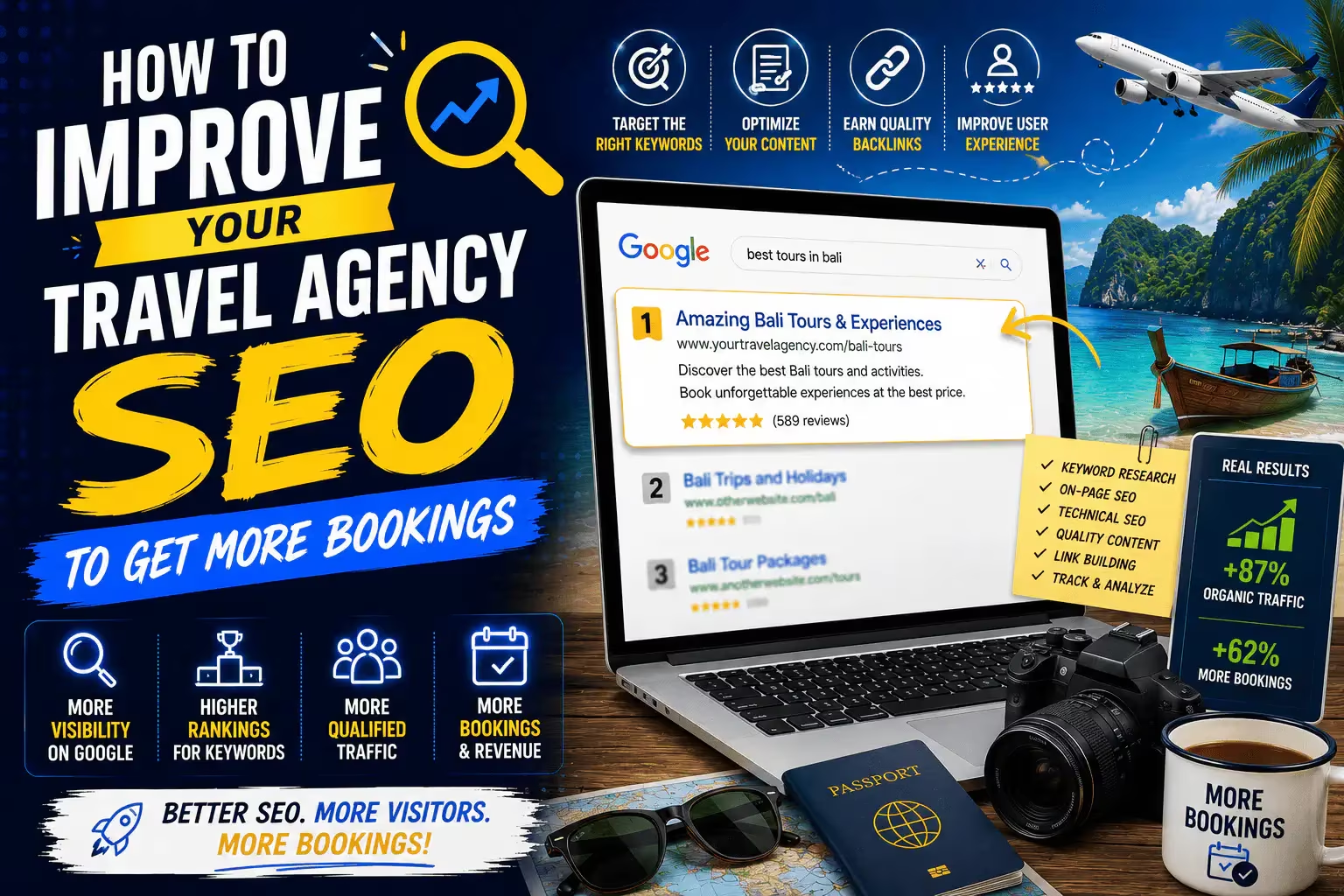
How to Improve Your Travel Agency SEO to Get More Bookings
Being first on Google is pointless if your traffic never converts into bookings. Here's how to link SEO and conversion for a tour operator.
Ranking first on Google guarantees zero bookings. That's the first thing tour operators need to understand. A site can generate thousands of visits per month and convert no one. Conversely, a site with modest but well-targeted, well-built traffic can fill a booking calendar.
SEO for a tour operator isn't a race for rankings. It's a complete chain: attract the right visitors, answer their search intent, and guide them to the booking request. This guide covers all three links.
Why is SEO different for a tour operator?
A tour operator doesn't sell a product you buy in one click. It sells a high-value experience, with a long decision journey and a huge emotional component. This completely changes the SEO approach compared to standard e-commerce.
Three tour operator specifics impact the SEO strategy.
Search intent varies widely. The same prospect types very different queries depending on their stage: "when to visit Patagonia" (inspiration), "Patagonia trek 15 days" (comparison), "Patagonia trek agency small group" (decision). Your site must capture all three intents with different pages.
The competition includes giants. On generic queries, you compete with OTAs (Booking, GetYourGuide) and large tour operators. You can't win head-on. The solution: specialization and the long tail.
Conversion depends on trust. Nobody books a €4,000 trip on impulse. SEO brings the traffic, but content, social proof, and the journey are what turn that traffic into bookings.
Which keywords actually drive bookings?
Not all keywords are equal. Some attract the curious, others attract buyers. For a tour operator, the distinction is crucial.
Transactional keywords (absolute priority)
These are queries typed by prospects ready to book. They often contain a destination name plus a commercial signal: "Nepal trek agency", "organized trip Kyrgyzstan", "Tanzania safari tour operator", "guided Patagonia tour price".
These queries have lower volume but a much higher conversion rate. They're what fill your booking calendar. Every destination you offer deserves a page optimized for its main transactional query.
Informational keywords (for traffic and trust)
These are preparation queries: "when to visit Kyrgyzstan", "what budget for a Nepal trek", "best season Tanzania safari". The prospect isn't ready to book yet, but they're building their decision.
These queries have high volume. By answering them via your blog, you capture the prospect early and demonstrate your expertise. Then you bring them back to your booking pages via internal linking. To structure this strategy, see our SEO guide for travel agencies.
The long tail: your best playing field
The long tail refers to very specific, low-volume queries: "Kyrgyzstan trek Song Kol lake 8 days", "Tanzania safari family children", "Patagonia expedition without agency". Individually, each query has little volume. Combined, they represent the majority of qualified traffic.
The advantage: competition is almost nonexistent on these queries, and intent is ultra-precise. A specialized tour operator can dominate hundreds of long-tail queries that OTAs ignore.
How to structure your site for SEO and conversion?
Your site structure determines both your search rankings and your conversion rate. Good architecture serves both.
One page per destination, optimized for booking
Each major destination must have its dedicated page, optimized for its transactional query. This page should contain: an H1 title with the target query, an immersive narrative of the experience, the detailed itinerary, practical information (price, dates, group, level), testimonials, and a clear call to action toward the quote or booking request.
This is the page that converts. It must be both optimized for Google and designed to inspire booking.
A blog that feeds destination pages
The blog captures informational traffic and redirects it to transactional pages. An article "When to visit Kyrgyzstan" should link to your "Kyrgyzstan Trek" page. This internal linking transfers SEO authority and guides the prospect toward booking.
Target 2 articles per month addressing your prospects' preparation questions. Each article is a gateway and a bridge to your sales pages.
Category pages for multiple destinations
If you offer several destinations in the same region (Central Asia, South America, Africa), create category pages. "Central Asia treks" can group Kyrgyzstan, Mongolia, Uzbekistan. These pages capture regional queries and distribute traffic to specific destination pages.
How to turn SEO traffic into bookings?
This is the most neglected link. Most SEO content stops at traffic. But for a tour operator, traffic without bookings has no value.
The contextual call to action
Each page must guide toward a precise action. On a destination page: "Request a quote for this trip". On a blog article: "Discover our Kyrgyzstan circuits". The CTA must reference the page content, not be a generic "Contact" button.
Social proof in the right place
Place testimonials just before the booking form, at the exact moment the prospect hesitates. A detailed client review ("The best trip of my life, perfect organization") placed next to the booking button removes the last objections.
A simple request form
The quote or booking form must be short: name, email, destination, approximate dates, number of participants. Every additional field drops the completion rate. To explore the choice between quote form and online booking, see our article showcase site or booking system for travel agencies.
Fast follow-up
SEO brings the prospect, but your responsiveness closes the sale. Respond to requests within 24 hours, ideally within 4 hours. A prospect waiting 3 days for a reply has already booked elsewhere.
What role does video content play in tour operator SEO?
Video is an underrated SEO lever for tour operators. It increases time spent on the page, a signal Google interprets as a quality indicator.
A destination page with a 2-minute film retains the visitor much longer than a text page. This longer visit time improves your ranking. And above all, video converts: it lets visitors experience the trip vicariously, which is exactly what a prospect needs before booking a high-value trip.
For a tour operator, the ideal is a brand film per flagship destination, complemented by short Reels embedded in the pages. Discover the impact of video on our video production for travel agencies page.
How to measure what actually generates bookings?
Without measurement, you're flying blind. Four indicators matter for a tour operator.
Organic traffic per page (Google Analytics): which pages attract traffic from Google. Identify your best-performing destination pages.
Rankings on your transactional queries (Search Console): are you on page 1 for "Nepal trek agency"? That's what counts, not your position on generic informational queries.
Conversion rate per page: how many visitors to a destination page fill out the form. This is the ultimate indicator. A highly visited page that doesn't convert has a content or CTA problem.
The origin of booking requests: when a prospect fills out your form, where did they come from? Which page brought them? This data tells you which content actually generates business. For a complete methodology, see our article how to measure your travel agency website ROI.
How long before seeing bookings via SEO?
SEO is a medium-term investment. For a tour operator, expect this realistic timeline.
Months 1-3: technical setup, destination page optimization, blog launch. Few visible results, but the foundations are laid.
Months 3-6: the first pages start ranking. Organic traffic increases. The first quote requests arrive via Google.
Months 6-12: destination pages reach page 1 on long-tail queries. Traffic becomes regular. SEO bookings become a predictable channel.
Beyond 12 months: SEO becomes your primary acquisition channel, the cheapest and most qualified. Articles published a year ago keep generating bookings.
Where to start this week?
Three concrete actions for a tour operator.
Audit your destination pages. For each destination, check: do you have a dedicated page? Does its title contain the transactional query ("Nepal trek agency")? Does it contain a clear CTA toward booking? If not, that's your priority.
Identify your 10 transactional queries. List the 10 queries your booking-ready prospects type. These should guide your page and content strategy.
Install Search Console and measure. If you haven't, install Google Search Console. Identify which queries you already appear for and at what position. That's your starting point.
At Nomia Studio, we build tour operator sites designed for both search rankings and conversion. From SEO structure to the booking journey, we build sites that turn Google traffic into clients. Book a free 30-minute discovery call. Also discover our travel agency website creation offer.
Questions fréquentes
Expect 3 to 6 months for the first requests via Google, and 6 to 12 months before SEO becomes a regular, predictable booking channel. Destination pages optimized for long-tail queries rank faster than for generic queries.
Transactional keywords first: those combining a destination and a commercial signal ("Nepal trek agency", "guided Patagonia tour price"). They have less volume but convert much better. Complement them with long-tail queries, where competition is low and intent is precise.
Traffic alone isn't enough. You need contextual calls to action on every page, social proof placed near the booking form, a simple request form, and fast follow-up (reply within 24 hours). SEO brings the prospect, the journey and responsiveness close the sale.
Not on generic queries, where OTAs dominate with huge budgets. But a specialized tour operator can dominate the long-tail and transactional queries OTAs ignore ("Kyrgyzstan trek Song Kol lake small group"). Specialization is the weapon that lets you win where the giants don't go.
Depuis le début ils nous font confiance pour la création de leurs contenu visuel ou web.