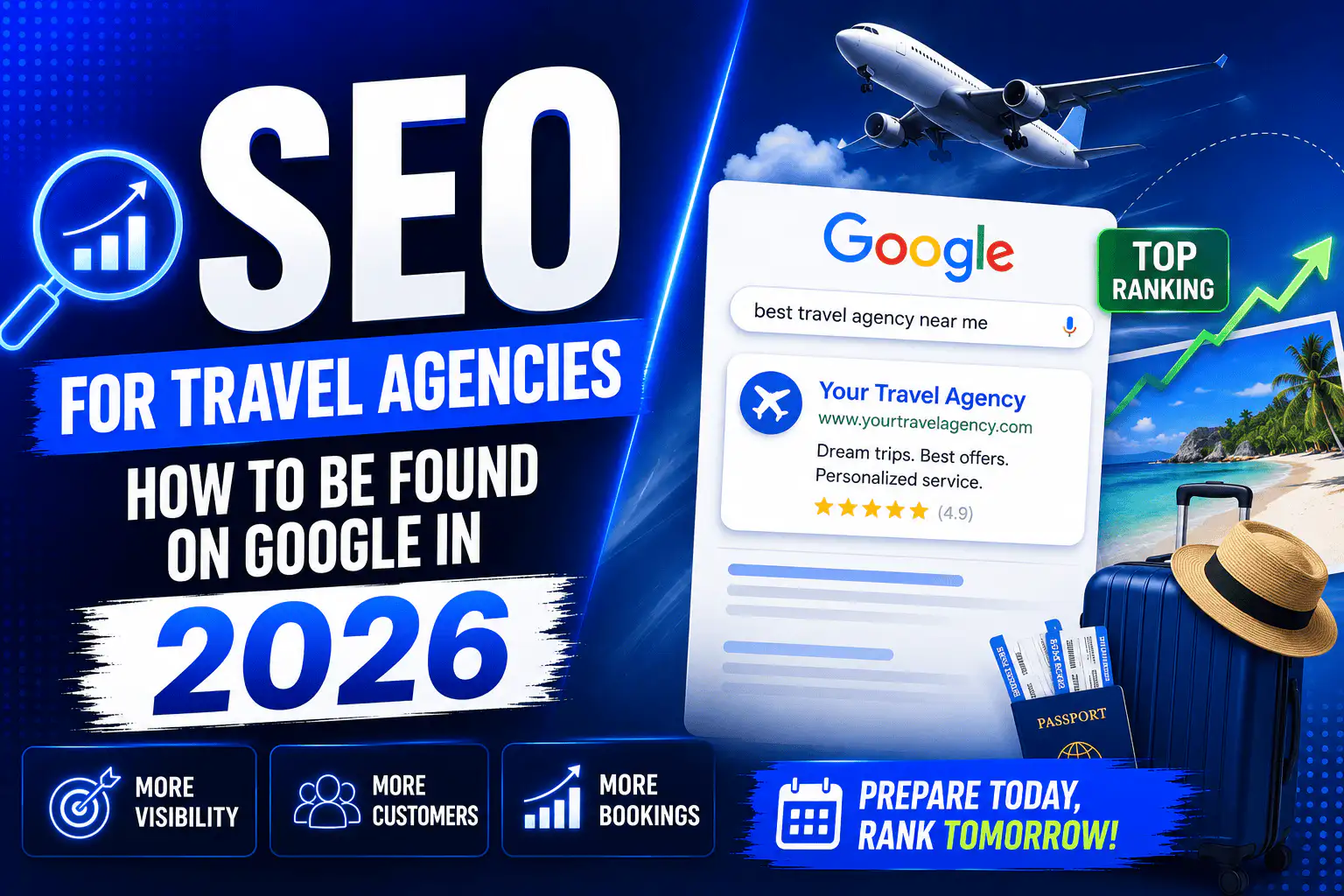
SEO for Travel Agencies: How to Get Found on Google in 2026
Your agency offers unique expeditions, but when a traveler types "Mongolia trek agency" into Google, it's your competitor that shows up first.
Your agency offers unique expeditions, but when a traveler types "Mongolia trek agency" into Google, it's your competitor that shows up first. The problem isn't your offering, it's your visibility. SEO (Search Engine Optimization) is the lever that makes your site appear in Google results when prospects are searching for exactly what you provide.
This guide covers everything a travel agency needs to know about organic search in 2026: technical foundations, content strategy, local SEO, and new opportunities linked to AI-generated answers.
Why is SEO the most cost-effective lever for a travel agency?
SEO is the only acquisition channel that becomes more powerful over time. Unlike advertising (which stops when you stop paying) or social media (which depends on algorithms you don't control), organic traffic is free, cumulative, and targeted.
A well-ranked article on "when to visit Kyrgyzstan" can attract 200 visitors per month for 3 years at zero additional cost. Multiply by 20 articles and you have 4,000 qualified monthly visitors arriving for free.
SEO also has a unique advantage in adventure tourism: your prospects run very specific searches. "Guided trek Mongolia small group" or "polar expedition price" are high purchase-intent queries. The traveler typing these is already convinced they want to go, they're just looking for who to go with.
What are the technical SEO basics for a travel website?
Before discussing content or blogging, your site needs to be technically solid. Without this foundation, even the best content won't rank.
Unique meta titles and descriptions
Every page needs a unique SEO title (50-60 characters) and an engaging meta description (120-155 characters). These are the texts Google displays in search results. A title like "Home" is a wasted opportunity. "Mongolia Trek in Small Groups | Your Agency" is a title that works for you.
The meta description doesn't directly influence ranking, but it influences click-through rate. A description that promises a clear answer ("Groups of 8 max, guaranteed departures, English-speaking guide. From €2,500.") generates more clicks than a vague description.
Loading speed
Google uses loading speed as a ranking factor, especially on mobile. Target: a PageSpeed Insights score above 80 on mobile. Travel sites are particularly vulnerable because they use many heavy images.
Three actions with the most impact: compress all images to WebP or AVIF (200-300 KB max per image), enable lazy loading for below-the-fold images, and choose a natively performant platform (Webflow excels here, WordPress requires optimization plugins).
Mobile-first responsive
Over 60% of travel-related searches happen on smartphones. Google indexes and ranks your site based primarily on its mobile version. If your site is unreadable on a phone, you're penalized even if the desktop version is perfect.
Heading structure
Use a clear hierarchy: one H1 per page (the main title), H2s for main sections, H3s for subsections. Google uses this structure to understand your content organization. An H1 like "Mongolia Trek: 15 Days on the Silk Road" is infinitely more effective than "Welcome."
Schema.org structured data
Structured data helps Google understand the nature of your content and can generate rich results (expandable FAQs, detailed information, review stars). For a travel agency site, the most relevant types are TravelAgency, TouristTrip, FAQPage, BlogPosting, and Review.
Implementation uses JSON-LD scripts in your site's code. It's technical but the impact is significant: rich results have a click-through rate 2 to 3 times higher than standard results.
XML sitemap and Google Search Console
Submit your XML sitemap in Google Search Console. This is the absolute baseline for Google to discover and index all your pages. Check indexation status regularly: if Google isn't indexing certain pages, there's a problem to solve (thin content, duplicate pages, technical errors).
How to build an SEO content strategy for tourism?
Technical SEO is the foundation. Content is the engine. Without content, your site can't rank for the thousands of queries your prospects type into Google.
Two types of content that work
Informational content answers your prospects' questions: "when to visit Mongolia," "how to prepare for a Nepal trek," "what budget for a Tanzania safari." These articles attract qualified traffic at the top of the funnel. The visitor isn't ready to buy yet, but they discover your expertise.
Commercial content targets purchase queries: "Mongolia trek agency," "Kyrgyzstan adventure travel price," "best safari agency Angola." These pages convert directly. They're your destination pages, service pages, and some comparative blog articles.
The key: a ratio of 70% informational content (for traffic) and 30% commercial content (for conversion), with internal linking between the two.
The blog: your main SEO weapon
An active blog is the most powerful SEO lever for a travel agency. Each article is a new entry point from Google. The target: 2 articles per month, 1,500 to 2,500 words, addressing real prospect questions.
Article types that work best: preparation guides ("How to prepare for a Kyrgyzstan trek"), budget articles ("How much does an Angola safari cost"), destination comparisons ("Mongolia vs Kyrgyzstan: which trek to choose"), and field experience narratives ("15 days on the Silk Road: a travel journal").
Each article should follow an AEO (Answer Engine Optimization) structure: H1 with the main question, opening paragraphs that directly answer the question, H2s structured as sub-questions, and internal links to your commercial pages.
Internal linking
Internal linking connects your blog articles to your commercial pages. An article "How to prepare for a trek in Mongolia" should contain a natural link to your "Mongolia Trek" page or your service page. This linking transfers SEO authority from the blog to the pages that convert.
Conversely, your commercial pages should link to relevant blog articles. Your travel agency website creation service page should contain links to your SEO and digital strategy articles.
How to optimize local SEO for a travel agency?
Local SEO is often overlooked by travel agencies selling online. That's a mistake. Even if your clients come from across the country, local signals reinforce your overall authority.
Google Business Profile
Create and optimize your Google Business Profile listing. Complete every field: name, address, phone, website, hours, category ("Travel agency"), description, photos, and services. Regularly publish posts (news, offers, blog articles).
Google reviews
Reviews strengthen both your local SEO and prospect trust. Systematically request a Google review from clients within 2 weeks of their return from a trip. Respond to every review, positive or negative, in a personalized way.
Professional directories
Register on relevant directories: industry associations, your local chamber of commerce, and regional tourism directories. Each listing creates a backlink to your site and a trust signal for Google.
What is AEO and why does it matter in 2026?
AEO (Answer Engine Optimization) is optimization for answer engines: ChatGPT, Perplexity, Claude, Google AI Overviews. In 2026, more and more travelers ask their questions directly to AI rather than Google.
When a traveler asks "What's the best agency for a Kyrgyzstan trek?", LLMs search for expert, specialized, well-structured content. Small agencies with detailed niche blogs have a better chance of being cited than large tour operators with generic listings.
How to optimize for LLMs
The llms.txt file is a text file placed at your site's root that describes your business, services, pages, and articles for AI. It's the equivalent of robots.txt but for LLMs.
Expert, specialized content is the key. LLMs value depth of expertise, not breadth. A blog of 15 detailed articles about Kyrgyzstan will be cited more than a catalogue of 200 destinations with no substantial content.
Schema.org structured data also helps LLMs understand your content. FAQPage, Article, and Organization types are particularly useful.
E-E-A-T signals (Experience, Expertise, Authoritativeness, Trustworthiness) matter as much for LLMs as for Google. A detailed "About" page with founder bios, field photos, number of trips organized, certifications, and client testimonials.
What backlinks should a travel website get?
Backlinks (links from other sites to yours) are the third SEO pillar, after technical foundations and content. Google interprets each backlink as a vote of confidence.
Most accessible backlinks
Your clients' and partners' sites. If you build websites for agencies (as we do at Nomia), a "Website by [Your Agency]" link in each client site's footer is a relevant, natural backlink.
Guest articles on tourism blogs, specialized media, or platforms like travel industry publications. Offer expert, original content, not promotional material.
Professional directories (industry associations, chambers of commerce) and web platform directories (Webflow Partners, if applicable).
Case studies and testimonials. If you've worked with local partners (ground operators, hotels, guides), ask for a link from their site.
What to avoid
Buying backlinks, mass link exchanges, and spam directories. Google penalizes these practices. Better to have 5 quality backlinks from relevant sites than 500 links from link farms.
What's a realistic SEO timeline for a travel agency?
SEO is a medium-term investment. Expect 3 to 6 months before significant results, and 6 to 12 months before regular traffic.
Month 1: Technical audit, fix meta tags, alt texts, speed. Install Google Analytics + Search Console. Submit sitemap.
Months 2-3: Launch the blog. First 4 articles targeting main queries. Set up internal linking. Create Google Business Profile.
Months 4-6: Regular publishing (2 articles/month). First visible results in Search Console (rising impressions). First backlinks obtained.
Months 6-12: Organic traffic grows month over month. Articles start ranking on page 1. First quote requests arrive via the blog. SEO becomes your primary acquisition channel.
For a complete roadmap integrating SEO, social media, email, and video, see our digital strategy guide for travel agencies.
How to measure your SEO results?
Four metrics are enough to steer your SEO.
Organic traffic (Google Analytics): the number of visitors arriving via Google. This is the primary indicator. It should grow each month if you publish regularly.
Average positions (Google Search Console): which queries you appear for and at what position. The goal is to move from page 2 (positions 11-20) to page 1 (positions 1-10).
Quote requests (conversion tracking): how many organic visitors fill out your contact form. This is the ultimate business metric.
Indexation (Google Search Console): how many of your pages are indexed by Google. If pages aren't indexed, they can't generate traffic.
For a complete measurement methodology, see our article how to measure your travel agency website ROI.
Where to start this week?
Three concrete actions, at zero cost.
Install Google Search Console if you haven't already. Submit your sitemap. Check how many pages are indexed. This is the foundation of everything.
Audit your meta titles. Open every page on your site and verify the SEO title is unique, descriptive, and contains your main keyword. "Home," "Page 1," or just your agency name are not SEO titles.
Identify your 5 priority keywords. These are the queries your prospects type when searching for what you offer. Example: "Mongolia trek agency," "Kyrgyzstan adventure travel," "Angola safari price." These 5 keywords guide your entire content strategy.
At Nomia Studio, SEO is built into every website we create for travel agencies. From technical structure to editorial blog, we build sites that get found on Google and convert. Discover our travel agency website creation offer.
Questions fréquentes
Expect 3 to 6 months before significant results (rising impressions and first organic clicks), and 6 to 12 months before regular traffic and inbound quote requests via Google.
Basic SEO (meta tags, structure, alt texts, structured data) should be included in any website creation service. An active SEO blog costs the writing time (2 to 4 hours per article) or €200 to €500 per article if outsourced. The ROI is excellent: a well-ranked article generates free traffic for 2 to 3 years.
Yes, in the vast majority of cases. A 5-page site without a blog has very little chance of ranking for competitive queries. The blog captures informational traffic (70% of your prospects' searches) and transfers authority to your commercial pages through internal linking.
SEO optimizes your site for search engines (Google, Bing). AEO (Answer Engine Optimization) optimizes for answer engines (ChatGPT, Perplexity, Claude, Google AI Overviews). Both are complementary: well-structured, expert, specialized content performs well on both fronts.
Depuis le début ils nous font confiance pour la création de leurs contenu visuel ou web.