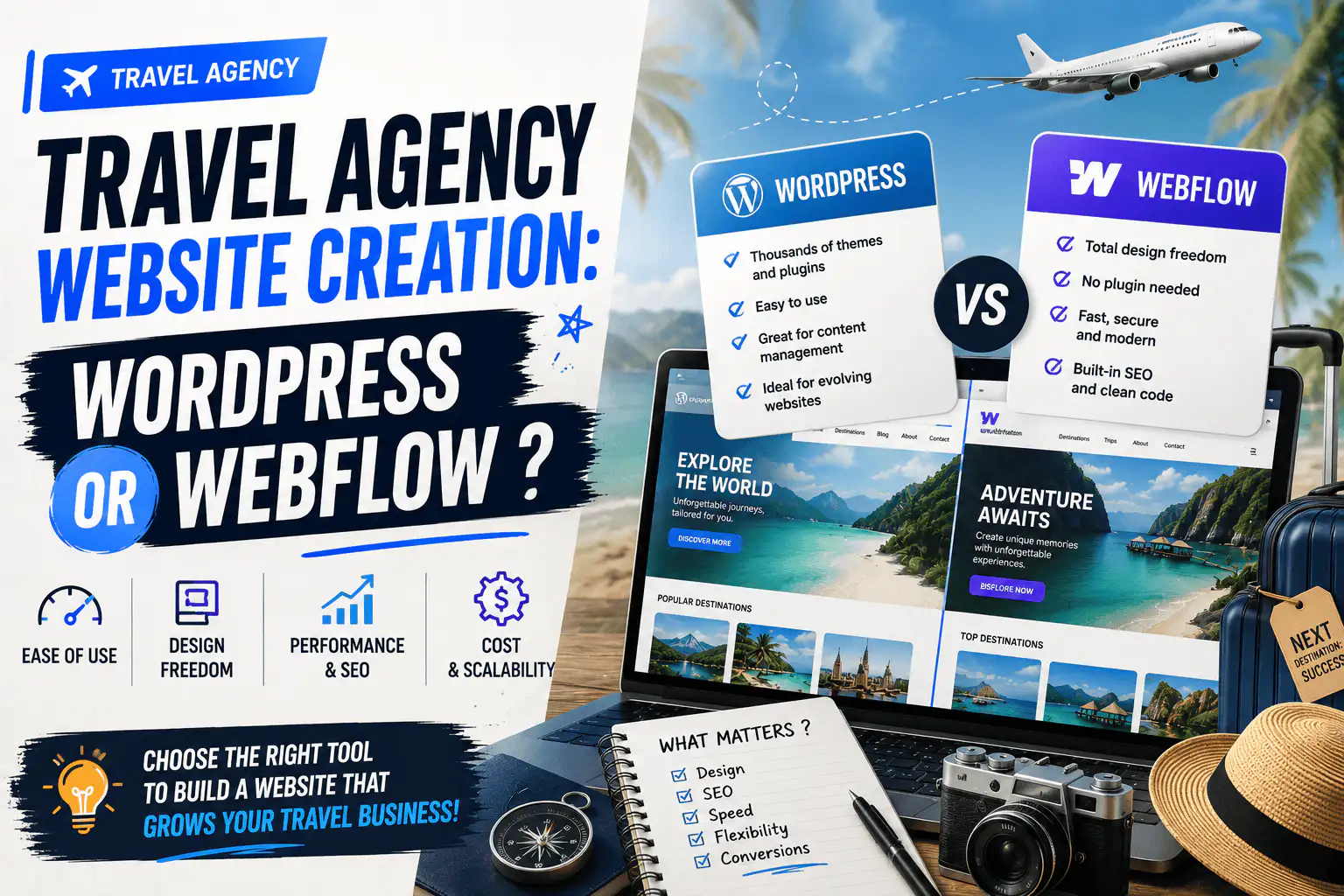
Travel Agency Website: WordPress or Webflow?
You've decided: your travel agency needs a website. The remaining technical question everyone asks: WordPress or Webflow? Both platforms dominate the web creation market in 2026, but they don't deliver the same results in the tourism sector.
You've decided: your travel agency needs a website. The remaining technical question everyone asks: WordPress or Webflow? Both platforms dominate the web creation market in 2026, but they don't deliver the same results in the tourism sector.
This article isn't a generalist comparison. It's a specific guide for travel agencies choosing between WordPress and Webflow for their website, focusing on what concretely impacts your bookings.
Why is the WordPress vs Webflow choice so critical for a travel agency?
Adventure tourism imposes three specific requirements that other sectors don't have to the same degree.
Visual impact. Your site must transport visitors before they read a word. Full-screen photos, hero video, fluid transitions. The platform must make this level of design possible without sacrificing speed.
Mobile performance. Over 60% of travel searches happen on smartphones. A slow or poorly adapted mobile site loses the majority of its visitors. And Google penalizes slow sites in its rankings.
Day-to-day autonomy. Changing a departure date, adding a circuit, publishing a blog post: you need to do this without calling a developer every time.
WordPress for creating a travel agency website: what to know
WordPress is the world's most used platform. About 40% of websites run on WordPress. It's a mature ecosystem with tens of thousands of themes and plugins.
What WordPress does well
The plugin ecosystem. Online booking (WooCommerce, Amelia), SEO (Yoast, RankMath), multilingual (WPML), forms, caching: there's a plugin for every need. This is WordPress's number one advantage.
Entry price. A WordPress site can be created from €1,500. Premium themes (€50-100) offer a professional base design. It's the most accessible solution for tight budgets.
Developer availability. WordPress is the most widespread web skill. You'll easily find a freelancer to work on your site.
What WordPress does less well in tourism
Native performance. A standard WordPress site with 15-20 plugins loads slowly. Typical PageSpeed score: 40-60 on mobile. Reaching 80+ requires caching plugins, a CDN, and specific optimization work.
Maintenance. WordPress updates, plugin updates (10 to 30 per site), theme updates. An update that breaks the site happens regularly. Budget 2 to 4 hours per month, or €100-300/month if outsourced.
Security. WordPress is the number one target for cyberattacks. Vulnerable plugins, brute force attacks, injections. An unmaintained site is a site at risk.
Limited design. Without a page builder (which slows the site) or custom theme (which is expensive), design is constrained by the chosen theme.
Webflow for creating a travel agency website: what to know
Webflow combines a powerful visual editor, an integrated CMS, and high-performance hosting. It's the platform we use at Nomia Studio for all our tourism projects.
What Webflow does well
Unlimited design. Total control, pixel by pixel, without writing code. Native animations, scroll transitions, full-screen video, complex layouts. The Nomadic Road site is a concrete example.
Native performance. Webflow generates clean code hosted on a global CDN. Typical PageSpeed score: 85-95 on mobile, without additional optimization.
Zero maintenance. No updates, no breaking plugins, no security vulnerabilities. Hosting is included ($14-39/month).
Intuitive CMS. Your teams modify destinations, dates, and blog posts autonomously via a simple visual interface.
What Webflow does less well
Fewer developers available. Webflow is less widespread than WordPress, especially in France. Working with a specialized tourism web agency that masters Webflow is all the more important.
No native plugins. For a complete booking system or member area, third-party tools must be integrated (Stripe, Calendly, Make).
Slightly higher initial cost. A professional Webflow site costs €3,500-6,000, versus €1,500-5,000 for WordPress. But the total 3-year cost is often lower thanks to zero maintenance.
Total cost comparison: WordPress vs Webflow over 3 years
WordPress over 3 years: Creation (€2,000-5,000) + hosting (€300-900) + maintenance (€3,600-10,800) + premium plugins (€600-1,500) = €6,500 to €18,200
Webflow over 3 years: Creation (€3,500-6,000) + Webflow hosting (€500-1,400) + maintenance (€0) = €4,000 to €7,400
Webflow is often cheaper over 3 years despite a higher creation cost. The difference comes entirely from maintenance: zero on Webflow, €100-300/month on WordPress.
For a detailed pricing guide, see our article how much does a travel agency website cost.
SEO impact for your agency
Both platforms enable good SEO. The difference is in the approach.
WordPress has the most mature SEO ecosystem (Yoast, RankMath). Fine-grained sitemap, redirect, and structured data management. But poor native performance penalizes SEO scores.
Webflow offers solid native SEO: meta tags, alt texts, 301 redirects, automatic sitemap, clean URLs. Fewer advanced features than Yoast, but superior native performance (a Google ranking factor) more than compensates.
For a complete tourism SEO strategy, see our SEO guide for travel agencies.
Client results: before/after WordPress → Webflow migration
De Verdwaalde Jongens: Dutch motorized travel agency. Previous WordPress site had never generated a measurable inbound inquiry. After migration to custom Webflow site + field video content: x10.7 ROI in 2 months, €80,000 in bookings.
Nomadic Road: 4x4 expedition agency. Complete Webflow redesign: +400% confirmed departures.
These results don't come from the platform alone. They come from the combination of immersive design + authentic content + conversion strategy, made more accessible by Webflow's flexibility and performance.
How to decide between WordPress and Webflow?
Four questions to settle it.
Do you need a complex booking system? If yes and volume justifies it → WordPress. If a well-designed quote form suffices (90% of adventure agencies) → Webflow.
Is immersive design a priority? If your site must inspire travel from the first second → Webflow.
Can you handle technical maintenance? If you have a trusted WordPress developer → WordPress is viable. If you want zero technical hassle → Webflow.
What's your total 3-year budget? If initial budget is under €2,000 → WordPress. If you think in total cost → Webflow is often more economical.
What if you already have a WordPress site?
Don't migrate on principle. First evaluate whether your current site meets its goals. If you answer no to 2 or more of these questions, a redesign is justified. See our complete guide on travel agency website redesign.
Where to start?
Define your real needs. List the features you actually need. This list guides the platform choice.
Compare providers, not platforms. An excellent WordPress developer will deliver a better site than a poor Webflow developer, and vice versa. Provider quality matters more than the platform.
Ask for concrete results. Not mockups, live sites with measurable results: traffic, quote requests, conversion rate.
At Nomia Studio, we chose Webflow as our exclusive platform for tourism after working with both. Book a 30-minute discovery call to discuss your project. Also discover our travel agency website creation offer.
Questions fréquentes
The WordPress software is free, but a professional site requires hosting (€100-300/year), a premium theme, plugins, and technical maintenance. The real cost of a professional WordPress site starts at €1,500 for creation and €100-300/month for maintenance.
Yes, Webflow is particularly well-suited to tourism thanks to its unlimited design capabilities (video, animations, full-screen images), native performance (PageSpeed score 85-95), intuitive CMS, and zero technical maintenance.
A professional travel agency website costs between €2,000 and €8,000 depending on the platform and complexity. The sweet spot is between €4,000 and €6,000 for a custom site with blog, SEO, and immersive design.
Yes, provided you set up 301 redirects from old WordPress URLs to new Webflow URLs. The site is rebuilt from scratch (no automatic conversion), which is also an opportunity to rethink design, content, and SEO strategy.
Depuis le début ils nous font confiance pour la création de leurs contenu visuel ou web.