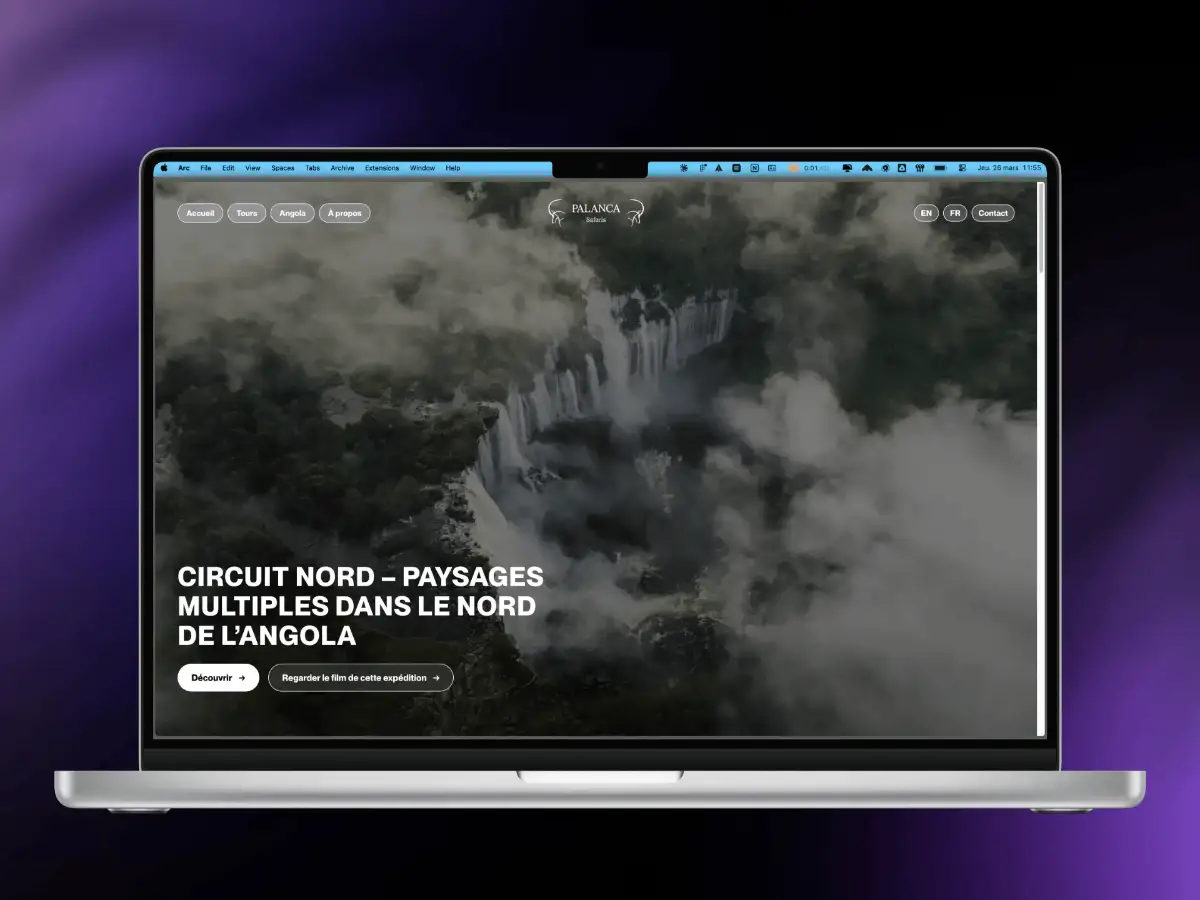
Website creation for travel agencies: 7 mistakes that cost you customers
Everything you need to know before creating a website for your travel agency. Process, platforms, functionalities, deadlines and budget
Building a website for a travel agency is a project that can transform your business or become a financial sinkhole. The difference rarely comes down to budget: it comes down to preparation, technical decisions, and understanding what your travelers actually expect from a website.
This guide covers the entire process, from initial planning to launch, drawing on our experience building sites for travel agencies and tour operators for over three years.
Why does your travel agency need a website in 2026?
The question may seem obvious, but many agencies still operate without a site or rely on a simple Facebook page. That's a problem for three reasons.
First, your prospects are searching for you on Google. When a traveler types "Mongolia trek agency" or "Kyrgyzstan expedition," they expect to find a professional website. If you don't show up, your competitor gets the inquiry. Even prospects who discover you through word-of-mouth or a trade show will check your website before reaching out.
Second, your website works 24/7. Unlike a trade show booth (3 days, €2,000 to €5,000) or advertising (which stops when you stop paying), your site generates inquiries continuously for 3 to 5 years.
Third, it's the only digital channel you truly own. Your Instagram followers, your Facebook page, your Google listing: all of that belongs to the platforms. They can change the rules overnight. Your website is your territory.
What features are essential for a travel agency website?
Not every agency needs the same features. But some are non-negotiable.
Must-have features
A CMS (content management system) so you can update destinations, add departure dates, and publish blog posts without depending on a developer. This is the foundation of autonomy.
Responsive design that adapts perfectly to mobile. Over 60% of travel-related searches happen on smartphones. A site that's unreadable on mobile means 60% of your visitors lost.
A quote request form that's clear and accessible from every page. This is your primary conversion point. Every page on your site should guide toward this form.
Dedicated destination pages with narrative content that inspires travel, not spec sheets. Each destination deserves its own SEO-optimized page.
A blog for SEO. Without a blog, your site is invisible on Google for 90% of your prospects' informational queries. It's the most cost-effective long-term traffic lever.
Recommended features
Multilingual support if you serve international clients. A bilingual French/English site doubles your potential audience.
Video integration to place promotional films as page heroes. Video significantly increases time on site and conversion rates. See our video production for travel agencies page to understand how to integrate video effectively.
Schema.org structured data (TravelAgency, TouristTrip, FAQPage) to help Google understand your content and generate rich results.
An analytics setup (Google Analytics 4 + Search Console) configured from launch day to measure performance.
What you probably don't need
A full online booking system. For adventure agencies with small groups and bespoke trips, a simple quote form is more suitable and far cheaper than a booking engine. Reserve booking systems for agencies selling standardized packages at volume.
A live chat. Unless you have someone to respond in real time, an abandoned chat does more harm than good. A visible phone number and a Calendly link are enough.
Which platform should you choose for a travel agency website?
Platform choice is one of the most structural decisions you'll make. Here are the three main options in 2026.
WordPress
The largest ecosystem: thousands of plugins, thousands of themes, easy to find a developer. But this flexibility comes at a cost. WordPress requires regular technical maintenance (updates, security, plugins breaking), performance is often poor without heavy optimization, and quality depends entirely on the developer.
Best if you want a lower-budget site (€1,500 to €3,000) and accept ongoing technical maintenance.
Webflow
Unlimited custom design, excellent native performance, hosting included, intuitive integrated CMS. This is the platform we use at Nomia Studio for all our tourism projects. It enables immersive design (large images, animations, video) without sacrificing loading speed.
Best if you want a premium site that reflects the quality of your experiences, with full content autonomy after delivery.
Squarespace / Wix
Intuitive interface, ready-made templates, no technical skills needed. But customization and SEO limitations quickly become a barrier for an agency that wants to grow.
Best for an independent travel consultant just starting out on a very tight budget.
Our recommendation: for a travel agency selling premium experiences, Webflow offers the best balance of design quality, SEO performance, and content management autonomy.
How does the website creation process work?
The complete process takes 4 to 10 weeks depending on complexity. Here are the key stages.
Phase 1: Strategic planning (week 1)
This is the most important phase. Before touching design, you need to clarify your positioning (who you are, who you serve, why you), define the site architecture (which pages, what hierarchy), inventory your existing content (photos, videos, testimonials, text), and set measurable goals (quote requests per month, target traffic).
A good provider always starts with this phase. If someone offers you a quote after a 3-line email, that's a red flag. For more on selection criteria, see our article on how to choose a web agency specialized in tourism.
Phase 2: Design and mockups (weeks 2-3)
Creating the site's visual identity: color palette, typography, layout, image style. The design must communicate your positioning before the visitor reads a single word.
In adventure tourism, design should be immersive. Full-screen images, generous visual sections, space for video. Avoid generic templates that make you look like every other agency.
Phase 3: Development and integration (weeks 3-6)
Building the site on your chosen platform, integrating content, configuring the CMS, implementing technical SEO (meta tags, alt texts, structured data, sitemap). This is also when video gets integrated if you have it.
Phase 4: Testing and optimization (weeks 6-7)
Testing across all devices (mobile, tablet, desktop), form verification, loading speed tests (target: PageSpeed score above 80 on mobile), content proofreading, SEO verification.
Phase 5: Launch and training (weeks 7-8)
Going live, configuring Google Analytics and Search Console, submitting the sitemap, and training you on CMS usage so you're fully autonomous.
How much does a travel agency website cost?
Budget depends on project complexity. Here are realistic ranges for 2026.
Essential showcase site (3 to 5 pages): €2,500 to €3,500. Custom design, responsive, basic SEO, contact form. Sufficient for a micro-agency just starting out.
Complete professional site (5 to 8 pages + blog): €4,000 to €6,000. This is the sweet spot for most agencies. Immersive design, CMS blog, multilingual, SEO strategy, configured analytics. See our detailed packages on our travel agency website creation page.
Premium site (8 to 12 pages + advanced features): €6,000 to €8,000. Detailed destination pages, video integration, advanced quote system, micro-animations, editorial content included.
Site with online booking: €8,000 to €20,000+. Booking engine, integrated payment, availability management. Rarely necessary for adventure agencies with small groups.
For a complete breakdown of hidden costs (hosting, photos, translation, maintenance), see our article how much does a travel agency website cost.
What mistakes should you avoid?
Five mistakes we see regularly that prove costly.
Starting with design before positioning. If you can't answer "why you over someone else?", no design will compensate. Positioning comes first.
Using stock photos. Travelers detect stock imagery immediately. If you don't have your own visual content yet, plan a photo/video budget alongside the website. A well-prepared field shoot covers 6 months of content for your site and social media.
Neglecting mobile. Your site will be viewed primarily on smartphones. If you only validate mockups on desktop, you're missing the point.
Forgetting SEO. A website without a search strategy is a website nobody finds. SEO isn't an add-on for later: it must be built into the structure, content, and technical foundation from day one.
Not measuring results. Install Google Analytics and Search Console from launch. If you don't measure, you can't improve. See our guide on how to measure your travel agency website ROI for setting up an effective measurement system.
Should you build it yourself or hire a professional?
The answer depends on your positioning and budget.
If you sell premium trips at €3,000+ per person, your website must reflect that quality. A DIY site on Wix won't communicate the same level of trust as a site built by a specialist. And in adventure tourism, trust is the number one decision factor.
If your budget is truly tight (under €2,000), a well-made DIY site is better than no site at all. But plan for a professional redesign as soon as your business allows it.
The ideal: a provider specialized in tourism who understands your sector, your customers, and your constraints. A generalist will build a beautiful site, but not necessarily one that converts travelers into clients.
Where to start?
Three actions to kick off your website project.
Clarify your positioning. Write in one sentence what makes you unique. "4x4 expeditions in Central Asian deserts" is positioning. "Tailor-made travel" is not.
Inventory your content. What photos do you have? What videos? What testimonials? Content is your website's fuel. Without authentic content, even the best design falls flat.
Contact 2 to 3 specialized providers. Compare approaches, portfolios, and processes. The right provider will ask questions about your business before talking about design.
Nomia Studio builds websites exclusively for travel agencies, tour operators, and expedition organizers. We analyze your situation during a free 30-minute discovery call. Discover our travel agency website creation offer.
Questions fréquentes
Webflow is the recommended platform for travel agencies who want a professional, efficient and controlled site. It offers total design flexibility, excellent SEO performance, and the ability to manage content without technical skills.
For a professional travel agency, hiring an expert is almost always more profitable. A professional delivers a site optimized for conversion and SEO from the start, whereas a DIY site requires months of additional optimizations.
The essential features are: an easy to use contact form, a showcase of inspiring destinations, visible customer reviews, a blog for SEO and a quick site in less than 3 seconds. Booking online is a plus but is not always necessary.
A tailor-made professional site requires between 4 and 8 weeks depending on the complexity. This time frame includes the design phase, development, content integration, and testing. Standardized solutions can go faster but at the expense of personalization.
Depuis le début ils nous font confiance pour la création de leurs contenu visuel ou web.